Widowhood
Young Captain Jack · The Son of a SoldierWidowhood in the novel is not merely a private state of mourning; it is the condition that holds together a household, preserves material evidence, and makes possible the eventual restoration of a broken family. Mrs. Ruthven's life as a widow places her at the center of Jack's upbringing, while the unresolved disappearance of Colonel Stanton's wife and son turns widowhood into part of a larger mystery of shipwreck, memory, and mistaken identity. Its conclusion is not a return to the past but a reorganization of the family through marriage, adoption, and recovered parentage.
Definition and Background
Widowhood is established through the aftermath of the wreck on Hemlock Bluff. Marion explains that when the wreck came ashore between ten and eleven years earlier, Jack had been a passenger on the vessel. The disaster separated him from his birth family and left the Ruthvens to raise him without knowing his true name or origin. The surviving household therefore treats Jack as an adopted son even while the circumstances of his parents' fate remain unresolved.
Mrs. Ruthven's widowhood is closely connected with this uncertainty. She has preserved the clothing belonging to Jack and his mother, a lace handkerchief, and a ring recovered after the wreck. The clothing and handkerchief are unmarked, while the ring once carried an inscription that had become too worn to read, even after two jewelers inspected it. When Jack asks to see it, Mrs. Ruthven brings out a small jewel casket containing the ring and the delicate handkerchief. These objects show how widowhood in the novel is expressed not only through loss but also through custodianship: Mrs. Ruthven keeps the fragments by which an absent family might one day be identified.
Widowhood and the Unresolved Family Mystery
The condition becomes narratively important because Jack's place in the Ruthven family is repeatedly challenged. Darcy Gilbert reports that Jack has been called a nobody who does not belong to the Ruthven family and may someday have to leave. Marion counters that Jack was adopted when he was three or four years old and is, in the eyes of the law, her brother. The contrast makes widowhood part of the story's conflict between social belonging and biological origin. Mrs. Ruthven's household has given Jack a family, but it cannot give him a verifiable birth history.
The evidence preserved by the widow gradually acquires new meaning. The wreck first appears as the source of Jack's arrival in the Ruthven household; later, Colonel Stanton's fevered speech recalls a shipwreck and his appeal that his wife Laura and his son Jack be saved. The colonel's resemblance to Jack strengthens the connection, but the decisive recognition comes when Mrs. Ruthven brings him the clothing, handkerchief, and wedding ring. Colonel Stanton identifies them as Laura's belongings and recognizes the child's dress, declaring that Jack is his son. The widow's private archive thus becomes the material bridge between a lost marriage and a restored father-and-son relationship.
Loss, Absence, and the Threat of Permanent Separation
Widowhood also intensifies the danger surrounding Jack. When Colonel Stanton asks about him, the answer is that Jack is missing, although there is no belief that he has been shot. The uncertainty recalls the original wreck: absence is never immediately equivalent to death, and a family may remain suspended between hope and bereavement. The possibility that Dr. Mackey is responsible makes the separation more threatening, because Jack's disappearance is connected to an active attempt to control his identity and inheritance.
The same pattern of concealment surrounds the black tin box recovered from the Nautilus wreck. Jack discovers it hidden in a tiny, filthy closet behind a door opened with a bent nail, finds that its padlock can be opened with one of his keys, and retrieves the papers inside. The box later turns up in the outlaws' camp among goods stolen from a trader and other valuables before being returned to Colonel Stanton. Its recovery supplies the papers needed to establish the Stanton fortune. Together with the ring and clothing preserved by Mrs. Ruthven, it turns a history of disappearance into a case supported by objects, testimony, and recovered documents.
Resolution and Transformation
The novel resolves widowhood through a new marriage rather than by restoring the dead or undoing the years of separation. After the Civil War ends, Colonel Stanton resigns from the army and prosecutes Dr. Mackey, who receives a ten-year prison term. Within a year, Colonel Stanton and Jack possess a fortune worth one hundred and fifteen thousand dollars. The legal and financial recovery gives the reunited father and son a future, but the household's emotional continuity still depends on Mrs. Ruthven.
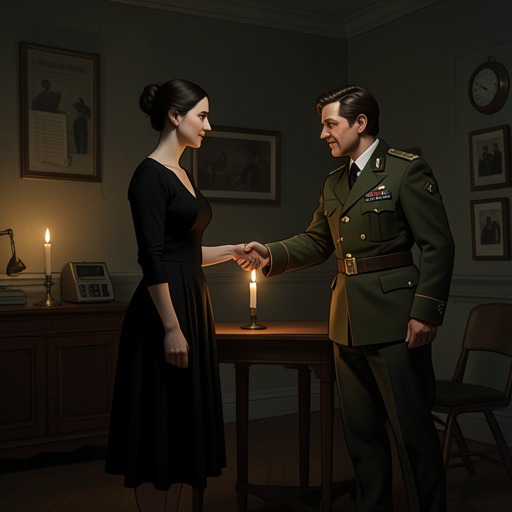
Colonel Stanton initially considers returning North, yet Mrs. Ruthven does not want to part with Jack. The decision is made for everyone to remain at the plantation, and a year later Colonel Stanton marries the widow. Mrs. Ruthven thereby becomes Mrs. Stanton and once again becomes Jack's mother, while Jack's status is simultaneously clarified as Colonel Stanton's biological son and preserved within the family that adopted him. Jack's satisfaction with the marriage shows that the resolution honors both forms of parenthood rather than treating adoption as a disposable substitute.
The wedding is part of a double ceremony: at the same time, Marion gives her heart to Dr. Harry Powell, who has established a lucrative medical practice in Philadelphia. Mrs. Mary Ruthven attends, while St. John Ruthven is notably absent. The conclusion therefore turns widowhood into a marker of transition. What began with an unexplained wreck, a missing husband, and a child without a known family ends with a remarriage, a reunited father and son, recovered property, and a household that remains at the plantation.